Database Storage
Once you have a processing pipeline crawling blocks, transactions, and logs, the next step is persisting that data. Nethereum provides EF Core-based storage for PostgreSQL, SQL Server, or SQLite. You can use the low-level repository layer to store data from custom processing pipelines, or use the pre-built hosted services that wire everything together as BackgroundService instances.
Packages
| Package | Purpose |
|---|---|
Nethereum.BlockchainStore.EFCore | Base DbContext, entity models, repository interfaces |
Nethereum.BlockchainStore.Postgres | PostgreSQL provider |
Nethereum.BlockchainStore.SqlServer | SQL Server provider |
Nethereum.BlockchainStore.Sqlite | SQLite provider |
Nethereum.BlockchainStorage.Processors | Hosted services (database-agnostic) |
Nethereum.BlockchainStorage.Processors.Postgres | PostgreSQL hosted service registration |
Nethereum.BlockchainStorage.Processors.SqlServer | SQL Server hosted service registration |
Nethereum.BlockchainStorage.Processors.Sqlite | SQLite hosted service registration |
Quick Start — Hosted Services
The simplest way to index blockchain data is with the hosted service packages. They run as BackgroundService instances, automatically handling progress tracking, retry with exponential backoff, and reorg detection.
PostgreSQL
dotnet add package Nethereum.BlockchainStorage.Processors.Postgres
var builder = Host.CreateApplicationBuilder(args);

builder.Services.AddPostgresBlockchainProcessor(
    builder.Configuration,
    connectionString: "Host=localhost;Database=blockchain;Username=postgres;Password=secret"
);

// Optional: index internal transactions (requires debug_traceTransaction RPC)
builder.Services.AddPostgresInternalTransactionProcessor();

var host = builder.Build();
await host.RunAsync();
SQL Server
dotnet add package Nethereum.BlockchainStorage.Processors.SqlServer
builder.Services.AddSqlServerBlockchainProcessor(
    builder.Configuration,
    connectionString: "Server=localhost;Database=blockchain;Trusted_Connection=true"
);
builder.Services.AddSqlServerInternalTransactionProcessor();
SQLite
dotnet add package Nethereum.BlockchainStorage.Processors.Sqlite
builder.Services.AddSqliteBlockchainProcessor(
    builder.Configuration,
    connectionString: "Data Source=blockchain.db"
);
builder.Services.AddSqliteInternalTransactionProcessor();
Configuration
All hosted services read from BlockchainProcessing in appsettings.json:
{
  "BlockchainProcessing": {
    "BlockchainUrl": "http://localhost:8545",
    "Name": "My Chain",
    "MinimumBlockConfirmations": 12,
    "FromBlock": null,
    "ToBlock": null,
    "ReorgBuffer": 12,
    "UseBatchReceipts": true,
    "NumberOfBlocksToProcessPerRequest": 1000,
    "RetryWeight": 50,
    "ProcessBlockTransactionsInParallel": true,
    "PostVm": false
  }
}
| Property | Default | Description |
|---|---|---|
BlockchainUrl | required | JSON-RPC endpoint |
MinimumBlockConfirmations | 12 | Blocks behind chain head before processing |
FromBlock | null | Starting block (if no prior progress) |
ToBlock | null | Stop at this block (null = continuous) |
ReorgBuffer | 0 | Re-check this many recent blocks for reorgs |
UseBatchReceipts | true | Use eth_getBlockReceipts for efficiency |
NumberOfBlocksToProcessPerRequest | 1000 | Log batch size |
RetryWeight | 50 | Reduce batch size on failures |
ProcessBlockTransactionsInParallel | true | Parallel transaction processing |
PostVm | false | Include VM stack traces |
Connection string resolution (PostgreSQL): explicit parameter > ConnectionStrings:PostgresConnection > ConnectionStrings:BlockchainDbStorage.
What Gets Stored
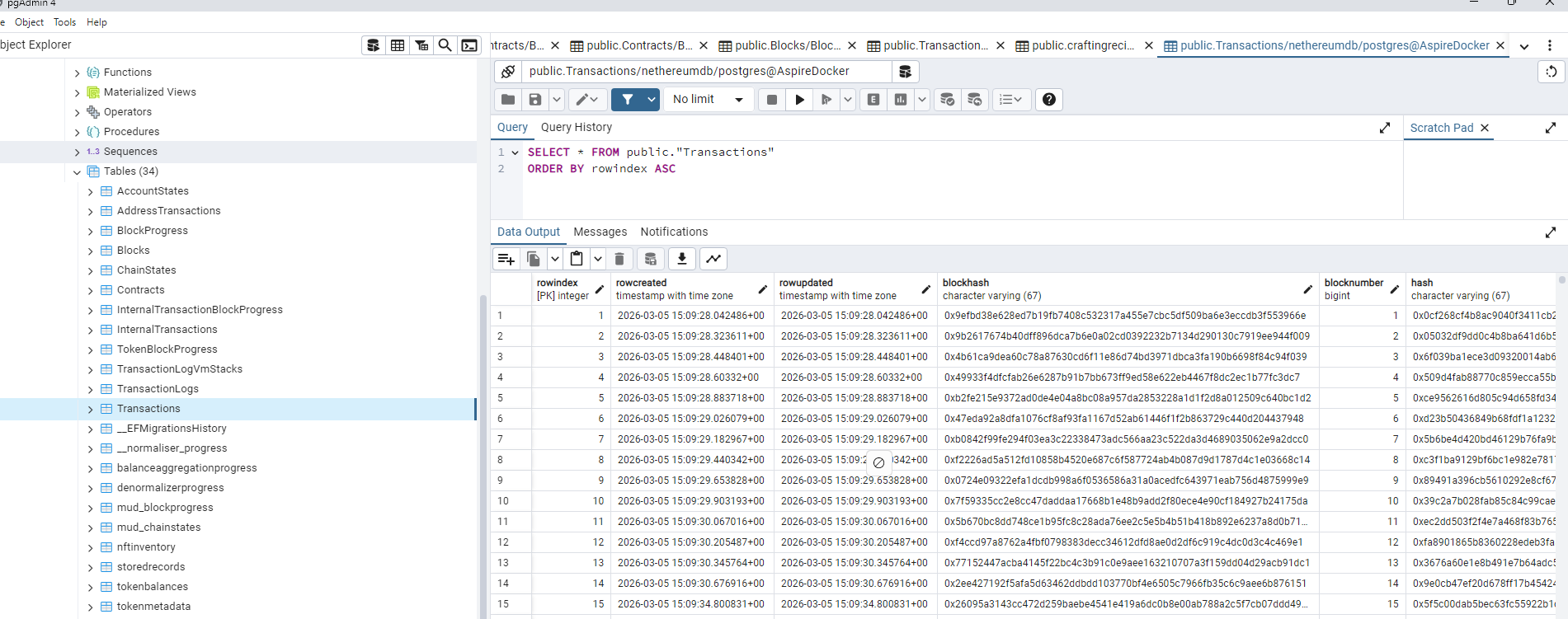
The hosted services persist all blockchain data into these tables:
| Table | Contents |
|---|---|
blocks | Block headers — number, hash, parent hash, gas, timestamp, miner |
transactions | Transactions — hash, from, to, value, gas, type, EIP-1559/4844 fields |
transactionlogs | Event logs — address, topics (indexed values), data |
contracts | Deployed contracts — address, creator, bytecode, ABI |
internaltransactions | Call traces — from, to, value, type (CALL/DELEGATECALL/CREATE), depth |
addresstransactions | Address-to-transaction index for fast account lookups |
blockprogress | Last processed block number |
chainstates | Chain ID, last canonical block hash (for reorg detection) |
All records include an IsCanonical flag for reorg handling. Non-canonical records are marked but not deleted, so you can query historical forks if needed.
Low-Level Repository API
If you need custom processing logic instead of the hosted services, use the repository factory directly:
builder.Services.AddPostgresBlockchainStorage(connectionString);
// This registers IBlockchainStoreRepositoryFactory and all individual repositories
Then inject and use repositories:
public class MyProcessor
{
    private readonly IBlockRepository _blockRepo;
    private readonly ITransactionRepository _txRepo;
    private readonly ITransactionLogRepository _logRepo;
    private readonly IBlockProgressRepository _progressRepo;

    public MyProcessor(
        IBlockRepository blockRepo,
        ITransactionRepository txRepo,
        ITransactionLogRepository logRepo,
        IBlockProgressRepository progressRepo)
    {
        _blockRepo = blockRepo;
        _txRepo = txRepo;
        _logRepo = logRepo;
        _progressRepo = progressRepo;
    }

    public async Task ProcessBlockAsync(BlockWithTransactions block)
    {
        await _blockRepo.UpsertBlockAsync(block.MapToStorageEntity());
        foreach (var tx in block.Transactions)
            await _txRepo.UpsertAsync(tx.MapToStorageEntity());
        await _progressRepo.UpsertProgressAsync(block.Number.Value);
    }
}
Repository Interfaces
| Interface | Key Methods |
|---|---|
IBlockRepository | UpsertBlockAsync, FindByBlockNumberAsync, GetMaxBlockNumberAsync, MarkNonCanonicalAsync |
ITransactionRepository | UpsertAsync, FindByHashAsync, MarkNonCanonicalAsync |
ITransactionLogRepository | UpsertAsync, FindByTransactionHashAndIndexAsync, MarkNonCanonicalAsync |
IContractRepository | UpsertAsync, FindByAddressAsync |
IInternalTransactionRepository | UpsertAsync, FindByTransactionHashAsync |
IBlockProgressRepository | UpsertProgressAsync, GetLastBlockNumberProcessedAsync |
IChainStateRepository | UpsertAsync, GetAsync |
IReorgHandler | HandleReorgAsync(fromBlock) |
Wire with BlockchainProcessing
Connect the repository factory to the block processing pipeline:
var web3 = new Web3("http://localhost:8545");
var repoFactory = serviceProvider.GetRequiredService<IBlockchainStoreRepositoryFactory>();

var processor = web3.Processing.Blocks.CreateBlockStorageProcessor(
    repositoryFactory: repoFactory,
    minimumBlockConfirmations: 12,
    configureSteps: steps =>
    {
        // Add custom handlers alongside the built-in storage handlers
        steps.BlockStep.AddSynchronousProcessorHandler(block =>
            Console.WriteLine($"Stored block {block.Number}"));
    }
);

await processor.ExecuteAsync(cancellationToken: cts.Token);
Internal Transaction Indexing
Internal transactions (call traces) are indexed by a separate hosted service that runs behind the main block processor:
// Requires debug_traceTransaction RPC support
builder.Services.AddPostgresInternalTransactionProcessor();
The service uses the callTracer to extract the full call tree for each transaction, storing:
- Call type (CALL, DELEGATECALL, STATICCALL, CREATE, CREATE2)
- From/to addresses, value, gas
- Input/output data
- Error and revert reason
- Trace depth and index
Schema Details
Entity Column Types
| Column Pattern | Max Length | Example Fields |
|---|---|---|
| Hash | 67 chars | hash, parenthash, transactionhash |
| Address | 43 chars | addressfrom, addressto, miner |
| BigInteger | 100 chars | value, gasused, gaslimit |
| Unlimited text | text (Postgres) / nvarchar(max) (SQL Server) | input, data, abi, code |
Key Indexes
| Entity | Unique Index | Additional Indexes |
|---|---|---|
| Block | (BlockNumber, Hash) | BlockNumber, Hash, ParentHash, (IsCanonical, BlockNumber) |
| Transaction | (BlockNumber, Hash) | Hash, AddressFrom, AddressTo, NewContractAddress |
| TransactionLog | (TransactionHash, LogIndex) | BlockNumber, Address, EventHash |
| InternalTransaction | (TransactionHash, Index) | BlockNumber |
| Contract | Address | -- |
Next Steps
- Token Indexing — Index ERC-20/721/1155 transfers and aggregate balances on top of the stored data
- Explorer — Embed a blockchain explorer UI over your indexed data
- Blockchain Processing — Review the processing pipeline and handler patterns